 

As someone who uses <a href="http://www.boffosocko.com">my own WordPress site</a> as a research notebook/tool and commonplace book (as well as for owning all of my own data and social posts), I'm <a href="http://boffosocko.com/2016/06/17/hypothes-is-and-the-indieweb/">already loving</a> this plugin and can see some tremendous potential for improvements on both it and on the hypothes.is platform in the future.

While I've played around with other platforms like Genius.com as well, Hypothes.is seems to have a more focused approach to how I prefer to use annotations, highlights, and marginalia on the web. It also has a growing API and related suite of tools which portend more flexibility and growth for the future.

Still, one must be cognizant for how these sometimes "hidden" tools can be used for abuse and bullying on the web: <a href="http://boffosocko.com/2016/04/07/webmentions-for-improving-annotation-and-preventing-bullying-on-the-web/">Webmentions for improving annotation and preventing bullying on the web</a>[http://boffosocko.com/2016/04/07/webmentions-for-improving-annotation-and-preventing-bullying-on-the-web/]


This is hopefully a simple, but useful feature request:
I appreciate that there's a filter for jetpack_allow_per_post_subscriptions, however it appears to only default to unchecked. It would be great if it could also be set (programattically or otherwise) to unchecked so that posts would always default to NOT be emailed to subscribers.

In my particular preferred use case, I'm using some advanced indiewebcamp.com related tools like micropub to allow services like Instagram (via OwnYourGram.com) and Foursquare/Swarm to post directly to my WordPress installation. In these cases, I'm posting with a remote service (perhaps similar to posting via email) and don't have access to the post interface to toggle the checkbox so that these posts don't automatically email subscribers. Conversely, when I'm using the direct posting interface, it's simple enough to toggle the checkbox manually.

To put it another way: Is there a way to add a line of code to the subscription filter [https://jetpack.com/support/subscriptions/#filters] so that the checkbox is both available AND it appears checked automatically?

For the same reason, if it doesn't already exist, it would also be nice to have the ability to toggle the checkboxes on the JetPack publicize feature as well. (If this already exists, then it's likely easy to borrow the code to accomplish the same thing for emailing subscribers).

Thanks to the entire team as always for a great product!


17w5131: Statistical & Computational Challenges in Large Scale Molecular Biology Workshop @BIRS_Math 3/2017 #ITBio

Arriving in Banff, Alberta Sunday, March 26 and departing Friday March 31, 2017

Organizers

  • Barbara Engelhardt (Princeton University)
  • Anna Goldenberg (University of Toronto)
  • Manolis Kellis (Massachusetts Institute of Technology)
  • Jacob Laurent (Centre national de la recherche scientifique)
  • Jeff Leek (John Hopkins University)
  • Stephen Montgomery (Stanford University)

Objectives

Over the past few years, an increasing number of large scale data sets have been made available in molecular biology. GTEx, for example, produced more than 18,000 RNA-Seq assays for multiple tissues in 900 individuals, Mindact generated gene expression data from about 7000 breast tumors in a single study, and 23andMe claims to have sequenced about 900,000 genomes. This growth in the available genomic data is expected to increase our capacity to identify cancer subtypes, regulatory genes, SNPs associated with phenotypes of interest, and biomarkers for many human traits. It also suggests exploring more complex feature representations when analyzing these datasets.

However, increasing the number of samples and features leads to a set of \textbf{interrelated statistical and computational problems}. Accordingly, the objectives of our workshop will be to:

Systematically identify the statistical and computational

problems arising during the analysis of large scale data in molecular biology;

Bring together experts in computational biology, molecular

biology, computer science, and statistics to propose innovative solutions to these problems, by leveraging recent advances in each of these fields.

Relevance, importance and timeliness

A number of studies generating high throughput molecular data for a large number of biological samples have been completed over the past five years. \textbf{Our workshop is important because the availability of these datasets holds great promises in terms of health improvement and understanding of molecular biology}. First of all, if exploited correctly, larger sample sizes should improve our ability to predict phenotypes of interest from molecular data. This entails very important applications such as improving the survival of cancer patients by better predicting which treatment they should receive, or decreasing bacterial resistances by predicting which antibiotic is efficient against a new strain. Correctly exploiting large scale datasets should also allow us to \textbf{better identify genetic and epigenetic determinants of these phenotypes, yielding a better understanding of human diseases and potentially guiding the development of new treatments and prevention policies}. In particular, more samples should allow the detection of less frequent variants in the human genome, or more complex features involving several modalities (copy number, expression, methylation, etc) associated with diseases. Finally, larger sample sizes should help with essential unsupervised tasks such as the \textbf{inference of regulation networks, or the identification of cancer subtypes}.

Our workshop is relevant because \textbf{all of these promises are conditioned on our solving of new statistical and computational challenges}. First (Challenge 1), we need to build new feature spaces and estimators whose complexity is adapted to these larger sample sizes, which involves designing novel, potentially more complex descriptors of the samples but still controlling the bias/variance trade-off. Second (Challenge 2), we need to build models which correctly integrate different modalities, such as copy number variation and gene expression. Third (Challenge 3), larger scale studies are more prone to unwanted variations, because they typically involve different labs and technical changes which can affect the measurements and become confounders in retrospective analyses. Similar or worse problems arise when trying to combine several existing datasets. We need methods which take this unwanted variation into account. Finally, (Challenge 4), we need new algorithms that make existing statistical tools scalable to the new sample sizes, and make estimation over the larger and more complex features of Challenge 1 tractable.

We also believe our workshop is very timely because \textbf{some of these statistical and computational challenges are starting to be addressed in other application fields} of statistics. It is crucial to recognize that the orders of magnitude are still very different in molecular biology and other data science application fields because of the cost and complexity of the data generation process: current large scale high throughput sequencing data sets typically contain a few thousand of samples but millions of features while computer vision, web, or astronomy datasets can involve billions or trillions of samples and relatively fewer features. A first consequence is that not all recent developments in machine learning are immediately transferable to computational biology. For example, so called deep learning methods have gained a lot of popularity and now represent the state of the art in computer vision but may not be the most appropriate tool for prediction of cancer outcome from molecular data. However, the fact that other fields already have much larger sample sizes also means that they had to develop efficient and scalable algorithms for basic tasks like feature selection, classification or clustering. \textbf{These recent developments are a great source of inspiration for computational biology, where large scale computation is still an emerging challenge}.

We believe \textbf{having a small scale workshop involving international experts in machine learning, statistics, computational biology and molecular biology is of utmost importance} for three main reasons. The first reason is that the technical advances we are referring to are very recent, often unknown to computational biologists and involve paradigms such as online optimization, accelerated gradient methods and network flow optimization, with which they are sometimes unfamiliar. The second reason is that it is not always obvious to non-statisticians which novel methods are appropriate given the current n/p regime. Conversely, the third reason is that statisticians do not know what the recent challenges are in molecular biology. Having them work on abstract versions of the problems is often not satisfactory as it is necessary to be aware of technical realities and of the underlying biology of the problem to come up with useful solutions.


17w5104: Mathematical Approaches to Evolutionary Trees and Networks Workshop @BIRS_math 2/12/17 #ITBio

Arriving in Banff, Alberta Sunday, February 12 and departing Friday February 17, 2017

Organizers


  • Leonid Chindelevitch (Simon Fraser University)
  • Caroline Colijn (Imperial College London)
  • Amaury Lambert (University Pierre and Marie Curie, Paris)
  • Marta Luksza (Institute of Advanced Study, Princeton University)
  • Vincent Moulton (University of East Anglia)
  • Tandy Warnow (University of Illinois)

Objectives

The objectives of the workshop are to bring mathematicians working in three key areas together to make progress in these problems. We will also invite several biologists who are keen to engage with mathematicians on the challenges posed by new data on evolutionary processes. Key challenges in the field at the moment are focused around the following emerging inter-related areas, each of which is raising mathematically interesting problems:

1. Inference with evolutionary trees and networks: Ultimately it is necessary not just to obtain evolutionary trees from data using standard methods, but to infer aspects of an underlying biological process. This requires understanding the likelihood of an evolutionary tree or network, or at least some of its informative features, using some stochastic process as the underlying ecological model. In principle, this approach allows simultaneous inference of both evolutionary trees and parameters of the ecological model. Coalescent theory has made considerable progress, for example, in obtaining tree likelihoods for sparsely sampled populations with geographical structure or with known past demographics (see for just one example [5]). In some simplified cases, epidemiological inference methods can estimate transmission trees [2], branching rates through time [5] and other aspects of epidemic spread [7]. However, none of these approaches is currently applicable if there is non-tree-like evolution, or where datasets are large. Furthermore, the range of models for which we can write down a tree likelihood is very limited. This raising nice new problems in probability, statistical inference and ecological modelling. Recently, more general processes (e.g. Lambda-coalescents, which allow multiple rather than strictly pairwise coalescent events) are beginning to be used to model populations with large offspring variance, or even to model selection in a non-parametric fashion [3]. This is potentially a powerful tool particularly for bacteria, which may acquire resistance to antibiotics and spread rapidly as a consequence, yielding both highly variable effective offspring numbers and a need to model selection carefully.

2. Understanding spaces of evolutionary trees: There are a large number of possible labelled, rooted binary trees for a given set of nn tips (ie for a given set of sequence data): (2n−3)!!=(2n−3)(2n−5)...(3)(1)(2n−3)!!=(2n−3)(2n−5)...(3)(1). This works out to 1018410184 trees on 100 tips; in contrast, current datasets for evolving bacteria contain thousands of tips. Not even the tools of Bayesian inference, the natural approach in such situations, can systematically explore spaces this big. This motivates the development of mathematical approaches for the exploration of tree space. These include new approaches to continuous tree spaces, including those from tropical geometry [8], and the use of tree metrics [1]. These in turn can lead to tools for averaging trees , and for navigating tree space in efficient ways [6] -- with profound applications in statistical inference from sequence data. Generalizing metrics to the case of evolutionary networks (for example tree-based networks) is another natural and important question. 

3. Summarising trees and networks using combinatorial tools: Uncovering shape features, spectral features and other ways to describe trees using quantities that are mathematically tractable will be of considerable interest [4]. As one example, where likelihoods are truly intractable, rapid tools for likelihood-free inference can be used to infer evolutionary processes from sequence data, but only where there are informative ways to summarize key features of the data. Trees are natural combinatorial structures with connections to data; for example, a binary tree is a sequence of partitions of the set of tips (sequences in a dataset), where each partition is one block smaller than the previous one, moving back through time from the partition with each tip on its own to the partition with all tips in one block as we move from the tips of the tree to the root. If the tree is not binary (ie it allows multifurcations), more than two blocks can combine at a branching event. Because of the natural link to partitions, the study of tree shapes links to the enumeration of partitions and to lattice path combinatorics. These in turn allow the characterization and enumeration of possible tree shapes. Meanwhile the study of motifs in other biological networks has been fruitful, and could be extended to tree and evolutionary network shapes. Trees and evolutionary networks are of course also graphs (with an added time dimension); the tools of algebraic graph theory are now finding application in this area of mathematical biology.

The community's response to the idea for this workshop has been very positive. A * beside a participant's name indicates that they have expressed enthusiasm for the workshop, and plan to attend. 

References [1] Louis J Billera, Susan P Holmes, and Karen Vogtmann. Geometry of the space of phylogenetic trees. Adv. Appl. Math., 27(4):733–767, November 2001. [2] Xavier Didelot, Jennifer Gardy, and Caroline Colijn. Bayesian inference of infectious disease transmission from whole-genome sequence data. Mol. Biol. Evol., 31(7):1869–1879, July 2014. [3] Alison M Etheridge, Robert C Griffiths, and Jesse E Taylor. A coalescent dual process in a moran model with genic selection, and the lambda coalescent limit. Theor. Popul. Biol., 78(2):77–92, September 2010. [4] Fanny Gascuel, Regis Ferriere, Robin Aguilee, and Amaury Lambert. How ecology and landscape dynamics shape phylogenetic trees. Syst. Biol., 64(4):590–607, July 2015. [5] Amaury Lambert and Tanja Stadler. Birth–death models and coalescent point processes: The shape and probability of reconstructed phylogenies. Theor. Popul. Biol., 90(0):113–128, December 2013. [6] Tom M W Nye. An algorithm for constructing principal geodesics in phylogenetic treespace. IEEE/ACM Trans. Comput. Biol. Bioinform., 11(2):304–315, March 2014. [7] David A Rasmussen, Erik M Volz, and Katia Koelle. Phylodynamic inference for structured epidemiological models. PLoS Comput. Biol., 10(4):e1003570, April 2014. 2 [8] David Speyer and Bernd Sturmfels. The tropical grassmannian. Adv. Geom., 4(3):389–411, 2004.


Sharing from the #IndieWeb on Mobile (Android) with Apps and @WithKnown

4 min read

I've been doing some work to find a better, easier, and cleaner way to share content, likes, replies, bookmarks, and reposts on mobile. In part it's what prompted me to write my post the other day about "Configuring the RSS Reader Woodwind for Known."

In part, I want to keep a complete record of posts that I "like", "share", "retweet", etc. on my own site, in keeping with the principles of the indieweb. Between separate indieweb installs of both WordPress and Known that I've been using for roughly the last two years, this hasn't been difficult on my laptop computer, primarily making use of a bevy of bookmarklet tools in my browser. In fact, on my laptop, it's down-right simple.

But not so on my Android mobile phone! In fact there, it's actually a really painful experience, and as a result I sometimes retweet, like and carry on in the Twitter app like the IndieWeb movement is dead to me. As a result I feel continually guilty and carry around a lot of . So I put out a call for help and got a few responses [1] [2] with some ideas. 

After playing around for a few days with two different apps, I thought I'd post some thoughts about the two different solutions, which to me are roughly the same.

Bookmarklet Free, which I found on Ryan Barrett's site which included some generally excellent instructions wasn't too bad.

URL Forwarder, was recommended by Tino Kremer, didn't include any instructions or hints at all.

Fortunately, both work roughly the same and the set ups aren't all too different for some of the set up for configuring Woodwind, mentioned above. Testing them out with Known allowed me to click the ubiquitous sharing icon in most Android apps that then triggered a pop-up allowing me to choose which app I want to share with.  Selecting either Bookmarklet Free or URL Forwarder then took me to an interstitial screen to let me choose whether I wanted to like, share, repost, bookmark, or reply to the particular content.

In most cases both bookmarklets did a reasonable and similar job, but typically they ended up sharing a section of unwanted text followed by a URL (and sometimes---depending on the app---another chunk of text related to the original content).  Typically I had to delete the extraneous "titling" text to leave the raw URL which Known then did a good job of reformatting properly to allow me to finish the post and send it off. (Kyle, Ryan, and Kevin had a short discussion on the handling of the "title" back in the day, which Known apparently hasn't implemented, but Ryan proffers some Github code to remedy the issue within the CMS.)

Between the two, I generally prefer the UI and set up for URL Forwarder a bit better. Both are roughly equivalent.

Since Ryan did a good job showing the configuration settings for Bookmarklet Free in his post, I'll include the similar settings for URL Forwarder for those using Known:

One need only to replace `www.yoursitenamehere.com` with their appropriate site URL.

Here, the action name, which appears first, is what I put in for the "Filter name" (field 1). The URL which follows was what I used for the "Filter url" (field 2). For each of these one should leave the "Replaceable text" field as "@url".
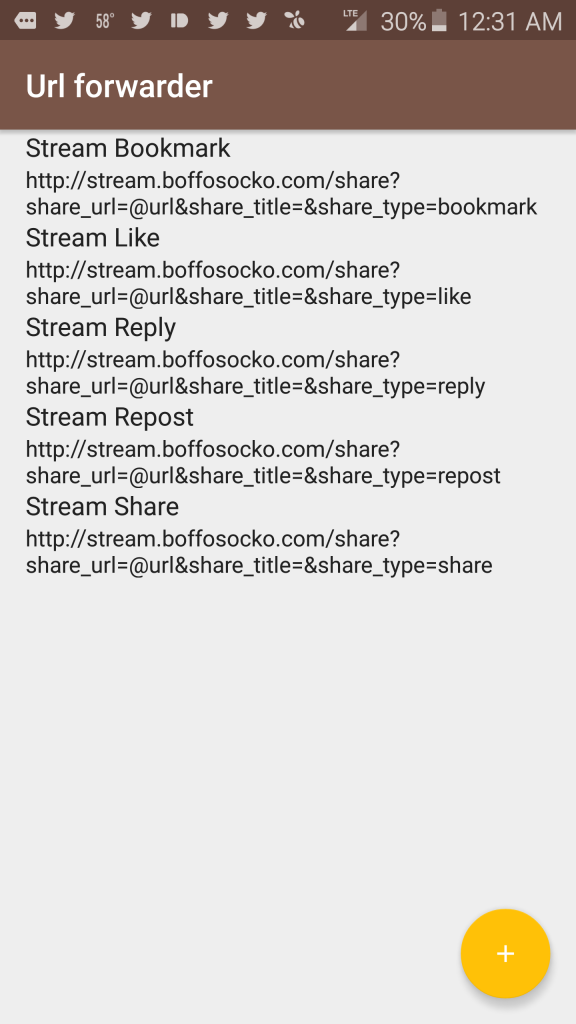
Screenshot Screenshot 2

Nota bene: I'm using the KnownReactions plugin to provide functionality for the "like" and "repost" types and that without it, these action types won't function properly on your Known installation.

Those at Known, are more than welcome to freely cut/paste/modify this for potential inclusion into their documentation for future use.

If anyone has other suggestions for improved posting via mobile, I'd certainly love to hear them!


I'm curious if anyone from is using any tools or perhaps @WithKnown?http://indiewebcamp.com/ https://withknown.com/


.@JohnsHopkins has an @Coursera sequence of 7 courses on Genomic Data Science starting soon.

Introduction to Genomic Technologies
Genomic Data Science with Galaxy
Python for Genomic Data Science
Command Line Tools for Genomic Data Science
Algorithms for DNA Sequencing
Bioconductor for Genomic Data Science
Statistics for Genomic Data Science
Genomic Data Science Capstone


I recall a few other resources in the same category as this. Here are a few links for meta-coverage on them, which may provide more beneficial than spending hours trying to delve into how to use them:
VidBolt: http://chronicle.com/blogs/profhacker/annotate-video-on-the-fly-a-review-of-vidbolt/56787
Socialbook: http://chronicle.com/blogs/profhacker/using-video-annotation-tools-to-teach-film-analysis/57171

Other tools of interest, which you'll see notes on in the comments to the two above articles:
VideoAnt: http://ant.umn.edu
ULBPodcast: https://github.com/ulbpodcast and http://ezcast.ulb.ac.be (open source code available)
Genius.com: http://boffosocko.com/2014/04/08/rap-genius/ Particularly take a look at http://lit.genius.com/ which is a great tool for classrooms to do small scale shared annotations and close reading with the benefit of full texts (in particular, try looking up the various creation stories, eg: Gilgamesh [http://genius.com/Epic-of-gilgamesh-tablet-1-the-coming-of-enkidu-annotated; Letters of Paul [http://genius.com/Laura-nasrallah-the-pauline-epistles-contents-annotated], which was part of HarvardX religious studies course and is an excellent example of using the platform for education]). There's also http://genius.com/history-genius.


This reminds me too of the visualization tool at http://www.chronozoom.com which I found by way of David Christian and Bill Gates's Big History Project (http://www.bighistoryproject.org) a while back. It has a variety of timelines that are interesting and valuable didactic tools.

In fact, as I think about it, since their project is aimed primarily at helping to provide highly integrated curriculum (physics, chemistry, anthropology, paleontology, biology, history, etc.) to high school teachers for high school students, you might consider some type of collaboration with their group to potentially assist in possibly providing curriculum out of the Azimuth Project. Having a more integrated and complex viewpoint on the world we live in can certainly encourage the next generation of students to help save what we've got.

I can provide more resources if you're interested, though it's quite a bit more than the comments section here could hold. A small start can be found in a brief review I wrote a few years back: http://boffosocko.com/2012/06/17/big-history/ 


I like what you've done with the final product and have always thought about doing something similar myself, particularly after I saw what Martin Fenner (https://plus.google.com/106537123721037364937/posts) did with his site at http://blog.martinfenner.org/ which actually allows others to make changes to it via github. Naturally, I'm also highly interested in his take on scholarly communication too, which makes me want to delve in there even more.

Another thing I've been playing around with lately has been some tools/toys at http://indiewebcamp.com primarily within WordPress (I noticed you had one at http://teaching.proftalbert.com/, so you're at least somewhat familiar) though also a bit with http://withknown.com which is a platform built specifically with education in mind (https://withknown.com/education/).

A large part of their philosophy is to own one's own data and then syndicate it out to other social media/external site, but some of their infrastructure allows one to easily make posts on one's own page which then act as replies on another's site. This is particularly interesting from the viewpoint of teaching wherein students and professors can interact with each other, but still have/own all of their individual work. (Incidentally, it also makes for using one's own site as a commonplace book of sorts, which I often find valuable.)

As an exmple, you'll notice on the post on my blog http://boffosocko.com/2015/05/21/category-theory-anyone/ got automatically syndicated to Google+ the other day. Then you replied to it within Google+ but my site sucked your comment back into the comments section on my original blog post, thereby keeping the conversation on my site and not only just on Google's.