
Biomedical and Electrical Engineer with interests in information theory, evolution, genetics, abstract mathematics, microbiology, big history, IndieWeb, mnemonics, and the entertainment industry including: finance, distribution, representation

boffosocko.com

chrisaldrich

chrisaldrich

+13107510548

chris@boffosocko.com

stream.boffosocko.com

www.boffosockobooks.com

chrisaldrich

mastodon.social/@chrisaldrich

micro.blog/chrisaldrich


@marshallk I ❤️ this idea too. I wonder if @KevinMarks has any solutions in his thinking about phatic communication that apply to email?


@matthilt There's a number of ways of doing this typically under the titles of POSSE or PESOS. Some for WordPress are documented here: https://indieweb.org/WordPress/Plugins#POSSE_Plugins
Specifically for Instagram, I think the majority use OwnYourGram.
Typically the more control you want over output for syndication means a bit more work upfront, while the easy solutions give you less control over how things look. Feel free to ask for opinions in chat as well either in the main channel or the channel.


"Medium hasn’t made it easy for publishers to leave with their full content..."
https://wptavern.com/wordpress-com-announces-new-importer-for-medium-posts


Shoniqua: This is a poor conspiracy theory at best.

Given the tight margins in publishing math texts, it's my experience that any but the top .01% actually make any real profit for the authors. Given my experience the vast majority of math textbook authors actually want to give away the answers and actually help students. in the past several years, I've directly emailed math professors who've written textbooks for help and advice and most of them have actually replied, not only promptly, but typically with more information that I requested about particular problems and often with full solutions, and in many cases they've sent met full sets of solutions for their entire texts and in a few other cases, they've sent me full electronic copies of their texts for free!

I'll also note, there's also been a growing trend for mathematicians to reserve the right to publish electronic copies of their books on their personal websites where they make them freely available to students.


17w5131: Statistical & Computational Challenges in Large Scale Molecular Biology Workshop @BIRS_Math 3/2017 #ITBio

Arriving in Banff, Alberta Sunday, March 26 and departing Friday March 31, 2017

Organizers

  • Barbara Engelhardt (Princeton University)
  • Anna Goldenberg (University of Toronto)
  • Manolis Kellis (Massachusetts Institute of Technology)
  • Jacob Laurent (Centre national de la recherche scientifique)
  • Jeff Leek (John Hopkins University)
  • Stephen Montgomery (Stanford University)

Objectives

Over the past few years, an increasing number of large scale data sets have been made available in molecular biology. GTEx, for example, produced more than 18,000 RNA-Seq assays for multiple tissues in 900 individuals, Mindact generated gene expression data from about 7000 breast tumors in a single study, and 23andMe claims to have sequenced about 900,000 genomes. This growth in the available genomic data is expected to increase our capacity to identify cancer subtypes, regulatory genes, SNPs associated with phenotypes of interest, and biomarkers for many human traits. It also suggests exploring more complex feature representations when analyzing these datasets.

However, increasing the number of samples and features leads to a set of \textbf{interrelated statistical and computational problems}. Accordingly, the objectives of our workshop will be to:

Systematically identify the statistical and computational

problems arising during the analysis of large scale data in molecular biology;

Bring together experts in computational biology, molecular

biology, computer science, and statistics to propose innovative solutions to these problems, by leveraging recent advances in each of these fields.

Relevance, importance and timeliness

A number of studies generating high throughput molecular data for a large number of biological samples have been completed over the past five years. \textbf{Our workshop is important because the availability of these datasets holds great promises in terms of health improvement and understanding of molecular biology}. First of all, if exploited correctly, larger sample sizes should improve our ability to predict phenotypes of interest from molecular data. This entails very important applications such as improving the survival of cancer patients by better predicting which treatment they should receive, or decreasing bacterial resistances by predicting which antibiotic is efficient against a new strain. Correctly exploiting large scale datasets should also allow us to \textbf{better identify genetic and epigenetic determinants of these phenotypes, yielding a better understanding of human diseases and potentially guiding the development of new treatments and prevention policies}. In particular, more samples should allow the detection of less frequent variants in the human genome, or more complex features involving several modalities (copy number, expression, methylation, etc) associated with diseases. Finally, larger sample sizes should help with essential unsupervised tasks such as the \textbf{inference of regulation networks, or the identification of cancer subtypes}.

Our workshop is relevant because \textbf{all of these promises are conditioned on our solving of new statistical and computational challenges}. First (Challenge 1), we need to build new feature spaces and estimators whose complexity is adapted to these larger sample sizes, which involves designing novel, potentially more complex descriptors of the samples but still controlling the bias/variance trade-off. Second (Challenge 2), we need to build models which correctly integrate different modalities, such as copy number variation and gene expression. Third (Challenge 3), larger scale studies are more prone to unwanted variations, because they typically involve different labs and technical changes which can affect the measurements and become confounders in retrospective analyses. Similar or worse problems arise when trying to combine several existing datasets. We need methods which take this unwanted variation into account. Finally, (Challenge 4), we need new algorithms that make existing statistical tools scalable to the new sample sizes, and make estimation over the larger and more complex features of Challenge 1 tractable.

We also believe our workshop is very timely because \textbf{some of these statistical and computational challenges are starting to be addressed in other application fields} of statistics. It is crucial to recognize that the orders of magnitude are still very different in molecular biology and other data science application fields because of the cost and complexity of the data generation process: current large scale high throughput sequencing data sets typically contain a few thousand of samples but millions of features while computer vision, web, or astronomy datasets can involve billions or trillions of samples and relatively fewer features. A first consequence is that not all recent developments in machine learning are immediately transferable to computational biology. For example, so called deep learning methods have gained a lot of popularity and now represent the state of the art in computer vision but may not be the most appropriate tool for prediction of cancer outcome from molecular data. However, the fact that other fields already have much larger sample sizes also means that they had to develop efficient and scalable algorithms for basic tasks like feature selection, classification or clustering. \textbf{These recent developments are a great source of inspiration for computational biology, where large scale computation is still an emerging challenge}.

We believe \textbf{having a small scale workshop involving international experts in machine learning, statistics, computational biology and molecular biology is of utmost importance} for three main reasons. The first reason is that the technical advances we are referring to are very recent, often unknown to computational biologists and involve paradigms such as online optimization, accelerated gradient methods and network flow optimization, with which they are sometimes unfamiliar. The second reason is that it is not always obvious to non-statisticians which novel methods are appropriate given the current n/p regime. Conversely, the third reason is that statisticians do not know what the recent challenges are in molecular biology. Having them work on abstract versions of the problems is often not satisfactory as it is necessary to be aware of technical realities and of the underlying biology of the problem to come up with useful solutions.


Sharing from the #IndieWeb on Mobile (Android) with Apps and @WithKnown

4 min read

I've been doing some work to find a better, easier, and cleaner way to share content, likes, replies, bookmarks, and reposts on mobile. In part it's what prompted me to write my post the other day about "Configuring the RSS Reader Woodwind for Known."

In part, I want to keep a complete record of posts that I "like", "share", "retweet", etc. on my own site, in keeping with the principles of the indieweb. Between separate indieweb installs of both WordPress and Known that I've been using for roughly the last two years, this hasn't been difficult on my laptop computer, primarily making use of a bevy of bookmarklet tools in my browser. In fact, on my laptop, it's down-right simple.

But not so on my Android mobile phone! In fact there, it's actually a really painful experience, and as a result I sometimes retweet, like and carry on in the Twitter app like the IndieWeb movement is dead to me. As a result I feel continually guilty and carry around a lot of . So I put out a call for help and got a few responses [1] [2] with some ideas. 

After playing around for a few days with two different apps, I thought I'd post some thoughts about the two different solutions, which to me are roughly the same.

Bookmarklet Free, which I found on Ryan Barrett's site which included some generally excellent instructions wasn't too bad.

URL Forwarder, was recommended by Tino Kremer, didn't include any instructions or hints at all.

Fortunately, both work roughly the same and the set ups aren't all too different for some of the set up for configuring Woodwind, mentioned above. Testing them out with Known allowed me to click the ubiquitous sharing icon in most Android apps that then triggered a pop-up allowing me to choose which app I want to share with.  Selecting either Bookmarklet Free or URL Forwarder then took me to an interstitial screen to let me choose whether I wanted to like, share, repost, bookmark, or reply to the particular content.

In most cases both bookmarklets did a reasonable and similar job, but typically they ended up sharing a section of unwanted text followed by a URL (and sometimes---depending on the app---another chunk of text related to the original content).  Typically I had to delete the extraneous "titling" text to leave the raw URL which Known then did a good job of reformatting properly to allow me to finish the post and send it off. (Kyle, Ryan, and Kevin had a short discussion on the handling of the "title" back in the day, which Known apparently hasn't implemented, but Ryan proffers some Github code to remedy the issue within the CMS.)

Between the two, I generally prefer the UI and set up for URL Forwarder a bit better. Both are roughly equivalent.

Since Ryan did a good job showing the configuration settings for Bookmarklet Free in his post, I'll include the similar settings for URL Forwarder for those using Known:

One need only to replace `www.yoursitenamehere.com` with their appropriate site URL.

Here, the action name, which appears first, is what I put in for the "Filter name" (field 1). The URL which follows was what I used for the "Filter url" (field 2). For each of these one should leave the "Replaceable text" field as "@url".
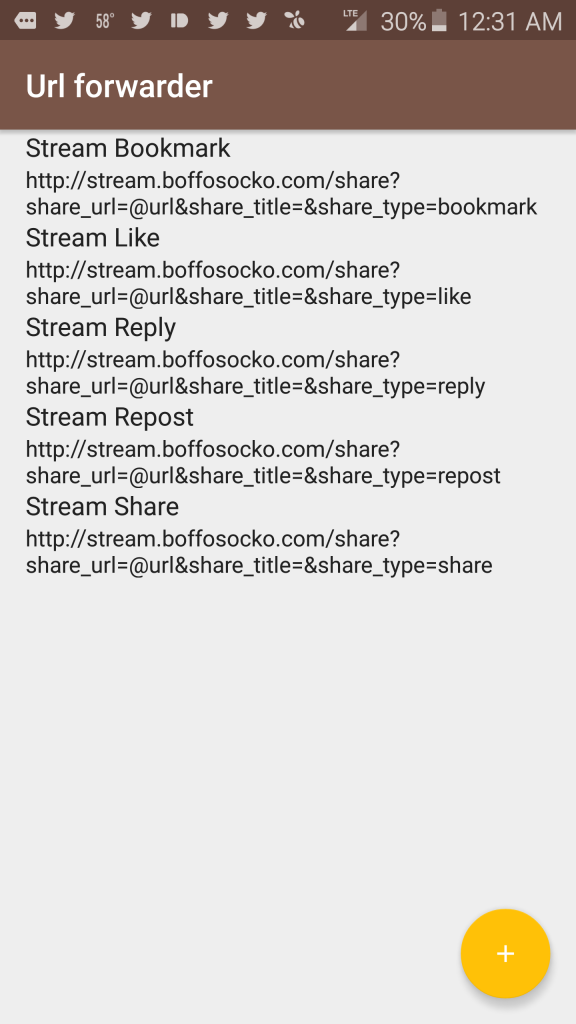
Screenshot Screenshot 2

Nota bene: I'm using the KnownReactions plugin to provide functionality for the "like" and "repost" types and that without it, these action types won't function properly on your Known installation.

Those at Known, are more than welcome to freely cut/paste/modify this for potential inclusion into their documentation for future use.

If anyone has other suggestions for improved posting via mobile, I'd certainly love to hear them!


Given the general purpose behind the wonderful design of the <a href="https://theme.wordpress.com/themes/pique/">Pique Theme</a>, I'm kind of surprised and shocked that it isn't WooCommerce compatible out of the box.

I'm aware of solutions like https://docs.woothemes.com/document/third-party-custom-theme-compatibility/, but has there been any discussion of putting the functionality in natively?

Has anyone done this already that can share code?


Far better than some of these band-aid solutions is to focus on the underlying economics of the problem and remedy those. Giving the end purchasers (aka students) and not the professors (aka middle-men) the power to choose books will drastically help to level the playing field. I've written some more specific thoughts and hints here: "To Purchase, Rent, or Pirate? The Broken Economics of Textbooks in the Digital Age" http://boffosocko.com/2015/08/24/to-purchase-rent-or-pirate-the-broken-economics-of-textbooks-in-the-digital-age/


This is a great article pinpointing the primary issue along with some more helpful advice on fixing the larger textbook problem than most of the traditional ever-green articles that hit the wire just prior to the start of a new term! However, if Congress is going to take steps, they may be better off trying to regulate the industry back into a more competitive shape, but this as unlikely to happen as the current Congressional plan. Instead, I'd recommend that students, professors, and universities fix the problem for the publishers by changing the word "Required" to "Recommended" in every syllabus in the country. Doing this would help allow students to pay as much for textbooks as they do for the average bestseller, which average about $15 and generally doesn't go over $40, even in hardback.

I've written some more specific details and thoughts on the roots of the issue here: "To Purchase, Rent, or Pirate? The Broken Economics of Textbooks in the Digital Age" http://boffosocko.com/2015/08/24/to-purchase-rent-or-pirate-the-broken-economics-of-textbooks-in-the-digital-age/ for those who'd like to delve more deeply into the problem and potential solutions.

Thanks BI, for helping to not only highlight the problem, but to push solutions. Given the thesis of Cesar Hidalgo's recent text "Why Information Grows", one of the greatest business issues America faces is making it easier for information to disseminate within our culture, and the excessive cost of textbooks and education is going to have drastic effects on our culture and country in the coming century.


David Spivak's Category Theory for the Sciences [http://www.amazon.com/gp/product/0262028131/ref=as_li_tl?ie=UTF8&camp=1789&creative=390957&creativeASIN=0262028131&linkCode=as2&tag=math01-20&linkId=SOMOC37JLZVBJMQH] has lots of great examples (with solutions depending on your edition) that comes about as close to such a text as you're likely to find. It rides a fine line between mathematics and engineering/sciences with a stronger foot in mathematics. Keep in mind that there are multiple versions of his "open" text available on the interwebs.[http://cat.boffosocko.com/textbooks/]