Biomedical and Electrical Engineer with interests in information theory, evolution, genetics, abstract mathematics, microbiology, big history, IndieWeb, mnemonics, and the entertainment industry including: finance, distribution, representation

boffosocko.com

chrisaldrich

chrisaldrich

+13107510548

chris@boffosocko.com

stream.boffosocko.com

www.boffosockobooks.com

chrisaldrich

mastodon.social/@chrisaldrich

micro.blog/chrisaldrich


Someone (@CSMoskell ?) at the @Hypothes_is conference on social annotation earlier today suggested using well annotated public web pages as examples could be helpful for adoption.

Here's an excellent project to use: https://framework.thoughtvectors.net/about/


@chuckfrey Primarily for note taking (90%) to feed both a WordPress site and an Obsidian database presently, but also for some social annotation (10%) with respect to things I see via https://annotations.lindylearn.io/new/ or individuals' feeds

My Obsidian store serves variously as a zettelkasten, commonplace book, and wiki simultaneously though each of these are discretely fragmented. Of course I could do most of the work via Hypothesis really without any other tools at all, presuming that the data would always be there.

Large swaths of Hypothes.is use is hiding within LMSs or is geared more toward social annotation in classrooms. I'm more interested in people using that content for their future selves or their creative endeavors.

You can find my publicly available material here: https://hypothes.is/users/chrisaldrich


@wiobyrne If you change the date/time linked URLs from
https://hypothes.is/a/Y03z2H4QEeiWPlcSnuxgKA to
https://hyp.is/Y03z2H4QEeiWPlcSnuxgKA
They'll link, instead of to the standalone versions which might be more appropriate for syndication link usage, to the original document on the web and auto-scroll to the location of the annotation. This might give you a tiny bit more of the UI functionality you're looking for.


@mrkrndvs I found a solid example of highlighting and annotation using my own website in conjunction with @pressfwd and @hypothes_is on a great @audreywatters piece. It's closer to some of the UI I'd like to have, though the CSS still needs work.
http://boffosocko.com/2017/05/10/un-annotated-by-audrey-watters/


@mrkrndvs I'm curious if you manually cut & paste your replies for others' sites (who may not support webmention or even pingback/trackback) into their old-school comments sections?

I often worry that without that, or without replying to versions on Twitter if they syndicated, they won't see my response via pingback/trackback or other means. Instead my reply sits all alone on my site and they don't have the benefit of seeing it at all unless they come across it organically otherwise.

Generally when I manually cut and paste replies, I'll often use the comment's "website" field to include the permalink for my comment and then I'll take the permalink for my comment and add it to my syndication links since I've manually syndicated it.

Sometimes I notice that including multiple links in a reply can also run afoul of spam filters.

One of my favorite set of machinations occurred recently when I wrote this reply to Jon Udell: http://boffosocko.com/2018/01/07/reply-to-annotating-web-audio-by-jon-udell/

Jon came back to his original post and appended his own comment to document my comment in the most circuitous of manners which included using his annotation tool Hypothes.is: https://blog.jonudell.net/2018/01/06/annotating-web-audio/#comment-474656

Interestingly we both used WordPress, Hypothes.is, and Twitter to carry on the conversation. I was quite impressed that he took the time to circle back around and document my end of the conversation since he must have missed my pingback (he doesn't have webmentions) and my manual cut & paste, but did manage to see the notification on Twitter.

It all just goes to show that you've got to keep your eye on the tech that you and everyone else is using until it's broadly and evenly distributed. One day perhaps...


Vocat.io

An interesting tool for annotating videos.


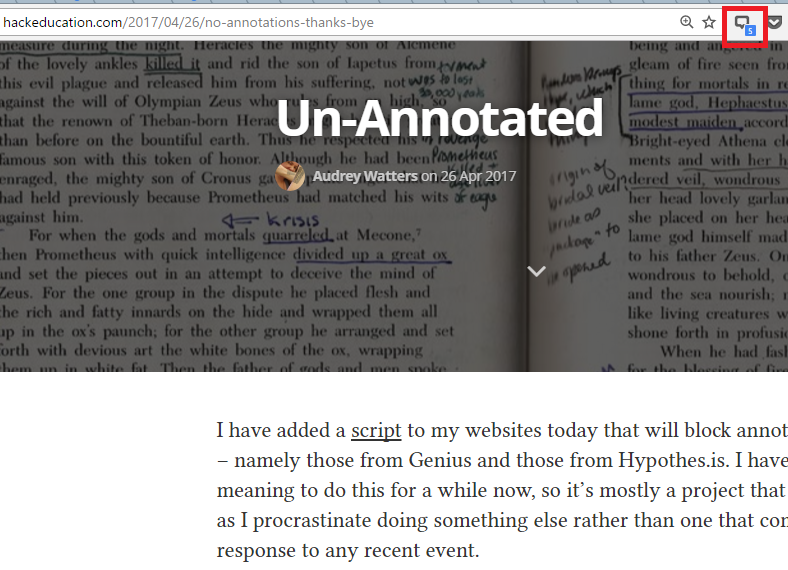
@audreywatters @mtechman @hypervisible @onewheeljoe Even with the script blocking @hypothes_is it is still possible to annotate hackeducation.com. Fortunately, though public annotations appear in the Chrome extension as existing, they don't physically appear on the site itself and need to be searched for manually to be found. I was able to do this with only just a few minutes of work, and could probably hack something more significant with some time/effort.
https://hypothes.is/a/KR0dXDYNEeeEH7_5Zf-ZuQ
http://boffosocko.com/wp-content/uploads/2017/05/annotation.png

Hypothes.is should really try to do a better job of preventing abuse in these types of situations so writers needn't worry about providing abusers the ability to use a writer's own platform to harass them. Perhaps borrowing the NIPSA concept from Flickr for flagged annotations and/or accounts? (NIPSA is an acronym for "Not In Public Site Areas", and an admin feature of Flickr that allows their support staff to mark an account such that posts from it will not be shown in search results and other similar public views of posts.)


(Consider Adding Web Annotations to WordPress) – WordPress Trac https://core.trac.wordpress.org/ticket/40031#comment:5

Mostly to provide some additional resources to the conversation I'll add the following:

Web Annotation Working Group's [https://www.w3.org/blog/news/archives/6156 three recommendations and two additional notes]

Prior to the WPTavern post which motivated the conversation, there was a [https://hypothes.is/blog/annotation-is-now-a-web-standard/ post written by Dan Whaley of Hypothes.is] who worked extensively within the group. This post has some interesting overview, but those interested in a fully implemented annotation platform (presumably using many of the pieces of the proposed standard) should take a quick look at [https://hypothes.is/ Hypothes.is], what it is and what it allows. Their front page has a pretty useful video introduction.

Keep in mind that some of the standard is geared specifically toward browsers and browser vendors, though WordPress could certainly implement some of the pieces from the CMS side.


@realkimhansen @signlfm If you hadn't been aware, this came out earlier in the week and may be of overlapping interest:
Three recommendations to enable Annotations on the Web | W3C News https://www.w3.org/blog/news/archives/6156
https://www.w3.org/annotation/
Their method of breaking down the problem and their vocabulary may be particularly useful; the overlay onto audio may be another problem altogether...

I also thought this post (with code) by Aaron Parecki, while a relatively simple concept, was exceptionally cool. https://aaronparecki.com/2017/02/19/4/day-61-media-fragments


Certainly an interesting and different way to do #annotation of older sources for the web. #IndieWeb

1 min read

<blockquote class="twitter-tweet" data-lang="en"><p lang="en" dir="ltr"><a href="https://twitter.com/hashtag/Facebook?src=hash">#Facebook</a> <a href="https://twitter.com/_Four_Horsemen">@_Four_Horsemen</a>  ...the individual is no longer a person, it’s a commodity: <a href="https://t.co/YTsGr2vUKy">pic.twitter.com/YTsGr2vUKy</a></p>&mdash; Blake B Wright (@WrightBlakeb) <a href="https://twitter.com/WrightBlakeb/status/649656823876861954">October 1, 2015</a></blockquote>

<script async src="//platform.twitter.com/widgets.js" charset="utf-8"></script>


I'm wondering if the @NYTimes used the Annotation Summit to make @Hypothes_is unusable on its site? https://hypothes.is/blog/poynter-annotation-summit-at-the-new-york-times/#annotations:8biIHrZREeapToOPmIU1UQ


Genetic variability in a frozen batch of MCF-7 cells invisible in routine authentication

Common recommendations for cell line authentication, annotation and quality control fall short addressing genetic heterogeneity. Within the Human Toxome Project, we demonstrate that there can be marked cellular and phenotypic heterogeneity in a single batch of the human breast adenocarcinoma cell line MCF-7 obtained directly from a cell bank that are invisible with the usual cell authentication by short tandem repeat (STR) markers. STR profiling just fulfills the purpose of authentication testing, which is to detect significant cross-contamination and cell line misidentification. Heterogeneity needs to be examined using additional methods. This heterogeneity can have serious consequences for reproducibility of experiments as shown by morphology, estrogenic growth dose-response, whole genome gene expression and untargeted mass-spectroscopy metabolomics for MCF-7 cells. Using Comparative Genomic Hybridization (CGH), differences were traced back to genetic heterogeneity already in the cells from the original frozen vials from the same ATCC lot, however, STR markers did not differ from ATCC reference for any sample. These findings underscore the need for additional quality assurance in Good Cell Culture Practice and cell characterization, especially using other methods such as CGH to reveal possible genomic heterogeneity and genetic drifts within cell lines.

Scientific