 

In a typical lottery, the primary function at action is statistical mechanics. By comparison, in most sports gambling scenarios one is betting against the pool of other betters and it is this pool that determines the odds. This is known as Parimutuel betting and can be compared with fixed-odds betting arrangements in which one is gambling against the house, which is setting the odds and payoff usually at the time of the bet, and those odds can shift through time until betting window closes as the house tries to spread out their risk to not only cover betting, but to make a profit.

I'm not sure which sportsbook you're quoting for the 5000-1 odds, but I would suppose that it is parimutuel and the house "sets" the game and takes a percentage off of the top (known as the rake or vigorish) as does the local government in taxes. The odds are then determined by the number of betters and the teams for which they're betting. If the pool of betters (presumably all having the same information) is "right", then the odds set are typically "correct" and the proper/fair payouts follow.

In cases where the betting pool is overly biased (perhaps there are more die hard fans for Man United who are betting with their hearts and not their brains) this can create situations known as "overlays" in which careful gamblers who notice the shift can take advantage of the situation and potentially have better-than-usual margins on their bets. Naturally these margins need to be big enough to overcome not only the inherent risk of the initial gamble, but also cover the loss of the houses's rake and the subsequent taxes. Serious handicappers will use all of the best available information available in making their gambling choices, but will then only proceed to place bets on which they perceive to be overlays. In the long run this will give them a slight edge (not over the house, but) over their fellow gamblers. They also typically place their bets just before the close of betting so that they have the most updated odds available (and can ensure their bet is still an overlay) while keeping in mind that their bet and other last-minute bets can potentially sway the ultimate odds. (example: If someone comes in at the last minute with several million pounds on Leicester City then the odds shift away from them, potentially creating overlays for other teams.)

In most cases, longshots with terrible odds like these, are longshots for a reason, but if a careful gambler has (preferably solid information creating) reason to believe that the odds shouldn't be as bad as they are, then it creates an overlay which makes the bet more valuable in comparison to all the other gamblers.

For statisticians, think of it as a normal curve whose local x-value along the y-axis is shifting (usually slightly) over time. If there's a huge bump in the outlying choices just before betting closes, then one's statistical likelihood of winning is better and it's a good bet with a better-than-average payoff. In practice, there are so many people gambling (usually intelligently) that these local shifts (sometimes called "noise" in engineering parlance) are fairly small and that in aggregate averaged over time most gambling situations are the mathematical equivalent of a numerical lottery.

As a similar somewhat related example, in US baseball, sabermetricians are gathering large amounts of data to attempt to find otherwise unseen inequities in forecasted player talent and then leverage that to try to win more baseball games. In the early days of applying these methods, one team could statistically do better than others, however over time, as more teams begin using the same methods, the information gap is overcome and everyone is on equal footing again. The trouble in most sports is that coming up with accurate measurements of performance isn't easy (or even statistically significant) and thereby adds a large enough layer of noise on top of the process that gambling on them is again relatively equivalent to the lottery.


After far too long, I've finally configured the email notifications on my Known install...


Is anyone else having issues with @cleverdevil's Reviews or Recipes showing up in @withknown 0.9.1? https://github.com/cleverdevil/Known-Reviews/issues


Kevin Marks's post on known.kevinmarks.com


Replied to a post on github.com :

Thanks @kylewm. This seems to have done the trick to fix the issue. ([viz.](http://stream.boffosocko.com/2016/liked-extending-press-this-in-wordpress-to-support-indieweb-reply)) You've got my vote for including KnownReactions into IDNO core if you need it!

I would consider the postability portion of this as closed. As the alternate post regarding Peter's SSL issue on https://github.com/idno/Known/issues/1360 is still being discussed, I'll leave that one open for the moment.


Replied to a post on github.com :

Is there a way to use a similar workflow that occurs when doing a native "photo post" rather than the alternate flow here that happens when clicking on the photo icon within the tinymce-esque toolbar? Doing something like this as a temporary mobile fix may be easy enough, and those who are looking to add the description, height, width could at least use raw html/css tweaks in the source code... (though I'll also mention that the source code icon pops up a fixed width window that also doesn't give access to it's full functionality either.)


Replied to a post on github.com :

@kylewm RE: Archaeology - This was actually the _easy_ part and is one of the greatest values of webmentions in general: once I'd found/seen the original post, having access to all the comments & mentions of that post in social media and other locations actually made it a no-brainer to find the conversation with the solution! (Though I do notice that there's a display issue on that original post with how my more recent webmentions from Known are showing up -- but that's another problem altogether.)


Peter Molnar mentioned this post [http://stream.boffosocko.com/2016/sharing-from-the-indieweb-on-mobile-android-with-apps-and/ ] in his article on Extending Press This in WordPress to support indieweb reply, like and repost [https://petermolnar.eu/press-this-indieweb/], but suspiciously without adding a direct mention of it, so I missed the ping which WordPress would have picked up as a pingback. (Known and WordPress aren't speaking to each other as well as one might like apparently.)

I'll have to come back to the code and thoughts in his post as some of the functionality would be nice to have in my WordPress install as well.


17w5104: Mathematical Approaches to Evolutionary Trees and Networks Workshop @BIRS_math 2/12/17 #ITBio

Arriving in Banff, Alberta Sunday, February 12 and departing Friday February 17, 2017

Organizers


  • Leonid Chindelevitch (Simon Fraser University)
  • Caroline Colijn (Imperial College London)
  • Amaury Lambert (University Pierre and Marie Curie, Paris)
  • Marta Luksza (Institute of Advanced Study, Princeton University)
  • Vincent Moulton (University of East Anglia)
  • Tandy Warnow (University of Illinois)

Objectives

The objectives of the workshop are to bring mathematicians working in three key areas together to make progress in these problems. We will also invite several biologists who are keen to engage with mathematicians on the challenges posed by new data on evolutionary processes. Key challenges in the field at the moment are focused around the following emerging inter-related areas, each of which is raising mathematically interesting problems:

1. Inference with evolutionary trees and networks: Ultimately it is necessary not just to obtain evolutionary trees from data using standard methods, but to infer aspects of an underlying biological process. This requires understanding the likelihood of an evolutionary tree or network, or at least some of its informative features, using some stochastic process as the underlying ecological model. In principle, this approach allows simultaneous inference of both evolutionary trees and parameters of the ecological model. Coalescent theory has made considerable progress, for example, in obtaining tree likelihoods for sparsely sampled populations with geographical structure or with known past demographics (see for just one example [5]). In some simplified cases, epidemiological inference methods can estimate transmission trees [2], branching rates through time [5] and other aspects of epidemic spread [7]. However, none of these approaches is currently applicable if there is non-tree-like evolution, or where datasets are large. Furthermore, the range of models for which we can write down a tree likelihood is very limited. This raising nice new problems in probability, statistical inference and ecological modelling. Recently, more general processes (e.g. Lambda-coalescents, which allow multiple rather than strictly pairwise coalescent events) are beginning to be used to model populations with large offspring variance, or even to model selection in a non-parametric fashion [3]. This is potentially a powerful tool particularly for bacteria, which may acquire resistance to antibiotics and spread rapidly as a consequence, yielding both highly variable effective offspring numbers and a need to model selection carefully.

2. Understanding spaces of evolutionary trees: There are a large number of possible labelled, rooted binary trees for a given set of nn tips (ie for a given set of sequence data): (2n−3)!!=(2n−3)(2n−5)...(3)(1)(2n−3)!!=(2n−3)(2n−5)...(3)(1). This works out to 1018410184 trees on 100 tips; in contrast, current datasets for evolving bacteria contain thousands of tips. Not even the tools of Bayesian inference, the natural approach in such situations, can systematically explore spaces this big. This motivates the development of mathematical approaches for the exploration of tree space. These include new approaches to continuous tree spaces, including those from tropical geometry [8], and the use of tree metrics [1]. These in turn can lead to tools for averaging trees , and for navigating tree space in efficient ways [6] -- with profound applications in statistical inference from sequence data. Generalizing metrics to the case of evolutionary networks (for example tree-based networks) is another natural and important question. 

3. Summarising trees and networks using combinatorial tools: Uncovering shape features, spectral features and other ways to describe trees using quantities that are mathematically tractable will be of considerable interest [4]. As one example, where likelihoods are truly intractable, rapid tools for likelihood-free inference can be used to infer evolutionary processes from sequence data, but only where there are informative ways to summarize key features of the data. Trees are natural combinatorial structures with connections to data; for example, a binary tree is a sequence of partitions of the set of tips (sequences in a dataset), where each partition is one block smaller than the previous one, moving back through time from the partition with each tip on its own to the partition with all tips in one block as we move from the tips of the tree to the root. If the tree is not binary (ie it allows multifurcations), more than two blocks can combine at a branching event. Because of the natural link to partitions, the study of tree shapes links to the enumeration of partitions and to lattice path combinatorics. These in turn allow the characterization and enumeration of possible tree shapes. Meanwhile the study of motifs in other biological networks has been fruitful, and could be extended to tree and evolutionary network shapes. Trees and evolutionary networks are of course also graphs (with an added time dimension); the tools of algebraic graph theory are now finding application in this area of mathematical biology.

The community's response to the idea for this workshop has been very positive. A * beside a participant's name indicates that they have expressed enthusiasm for the workshop, and plan to attend. 

References [1] Louis J Billera, Susan P Holmes, and Karen Vogtmann. Geometry of the space of phylogenetic trees. Adv. Appl. Math., 27(4):733–767, November 2001. [2] Xavier Didelot, Jennifer Gardy, and Caroline Colijn. Bayesian inference of infectious disease transmission from whole-genome sequence data. Mol. Biol. Evol., 31(7):1869–1879, July 2014. [3] Alison M Etheridge, Robert C Griffiths, and Jesse E Taylor. A coalescent dual process in a moran model with genic selection, and the lambda coalescent limit. Theor. Popul. Biol., 78(2):77–92, September 2010. [4] Fanny Gascuel, Regis Ferriere, Robin Aguilee, and Amaury Lambert. How ecology and landscape dynamics shape phylogenetic trees. Syst. Biol., 64(4):590–607, July 2015. [5] Amaury Lambert and Tanja Stadler. Birth–death models and coalescent point processes: The shape and probability of reconstructed phylogenies. Theor. Popul. Biol., 90(0):113–128, December 2013. [6] Tom M W Nye. An algorithm for constructing principal geodesics in phylogenetic treespace. IEEE/ACM Trans. Comput. Biol. Bioinform., 11(2):304–315, March 2014. [7] David A Rasmussen, Erik M Volz, and Katia Koelle. Phylodynamic inference for structured epidemiological models. PLoS Comput. Biol., 10(4):e1003570, April 2014. 2 [8] David Speyer and Bernd Sturmfels. The tropical grassmannian. Adv. Geom., 4(3):389–411, 2004.


Sharing from the #IndieWeb on Mobile (Android) with Apps and @WithKnown

4 min read

I've been doing some work to find a better, easier, and cleaner way to share content, likes, replies, bookmarks, and reposts on mobile. In part it's what prompted me to write my post the other day about "Configuring the RSS Reader Woodwind for Known."

In part, I want to keep a complete record of posts that I "like", "share", "retweet", etc. on my own site, in keeping with the principles of the indieweb. Between separate indieweb installs of both WordPress and Known that I've been using for roughly the last two years, this hasn't been difficult on my laptop computer, primarily making use of a bevy of bookmarklet tools in my browser. In fact, on my laptop, it's down-right simple.

But not so on my Android mobile phone! In fact there, it's actually a really painful experience, and as a result I sometimes retweet, like and carry on in the Twitter app like the IndieWeb movement is dead to me. As a result I feel continually guilty and carry around a lot of . So I put out a call for help and got a few responses [1] [2] with some ideas. 

After playing around for a few days with two different apps, I thought I'd post some thoughts about the two different solutions, which to me are roughly the same.

Bookmarklet Free, which I found on Ryan Barrett's site which included some generally excellent instructions wasn't too bad.

URL Forwarder, was recommended by Tino Kremer, didn't include any instructions or hints at all.

Fortunately, both work roughly the same and the set ups aren't all too different for some of the set up for configuring Woodwind, mentioned above. Testing them out with Known allowed me to click the ubiquitous sharing icon in most Android apps that then triggered a pop-up allowing me to choose which app I want to share with.  Selecting either Bookmarklet Free or URL Forwarder then took me to an interstitial screen to let me choose whether I wanted to like, share, repost, bookmark, or reply to the particular content.

In most cases both bookmarklets did a reasonable and similar job, but typically they ended up sharing a section of unwanted text followed by a URL (and sometimes---depending on the app---another chunk of text related to the original content).  Typically I had to delete the extraneous "titling" text to leave the raw URL which Known then did a good job of reformatting properly to allow me to finish the post and send it off. (Kyle, Ryan, and Kevin had a short discussion on the handling of the "title" back in the day, which Known apparently hasn't implemented, but Ryan proffers some Github code to remedy the issue within the CMS.)

Between the two, I generally prefer the UI and set up for URL Forwarder a bit better. Both are roughly equivalent.

Since Ryan did a good job showing the configuration settings for Bookmarklet Free in his post, I'll include the similar settings for URL Forwarder for those using Known:

One need only to replace `www.yoursitenamehere.com` with their appropriate site URL.

Here, the action name, which appears first, is what I put in for the "Filter name" (field 1). The URL which follows was what I used for the "Filter url" (field 2). For each of these one should leave the "Replaceable text" field as "@url".
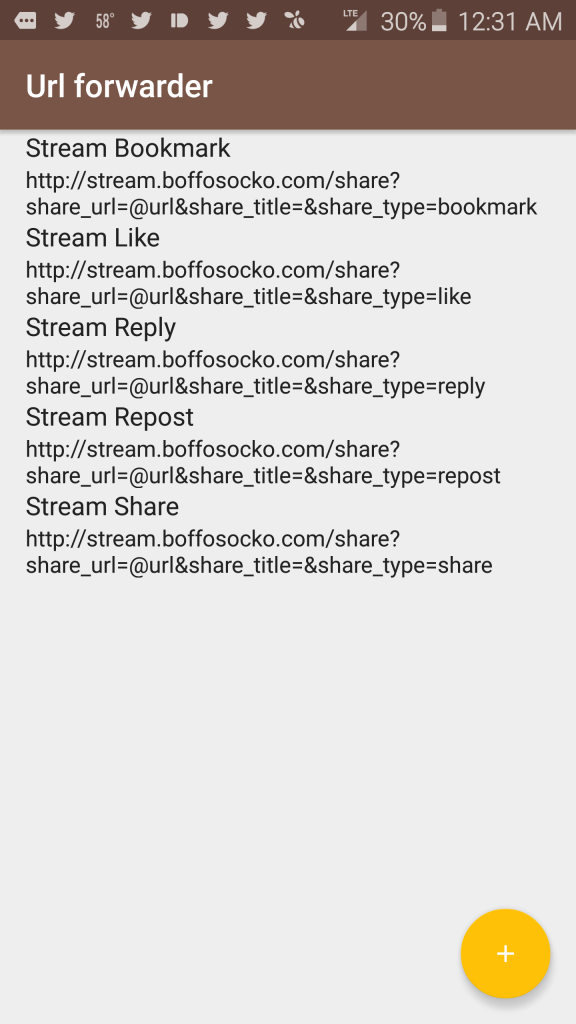
Screenshot Screenshot 2

Nota bene: I'm using the KnownReactions plugin to provide functionality for the "like" and "repost" types and that without it, these action types won't function properly on your Known installation.

Those at Known, are more than welcome to freely cut/paste/modify this for potential inclusion into their documentation for future use.

If anyone has other suggestions for improved posting via mobile, I'd certainly love to hear them!


Replied to a post on erinjo.xyz :

I've noticed in many places on http://www.indiewebcamp.com your old URL still appears instead of your newer .xyz TLD. May want to swing by and update them. I tweaked the one at http://indiewebcamp.com/known which is probably the worst offender, though there are undoubtedly others.


Configuring the #IndieWeb RSS Reader Woodwind for @WithKnown

4 min read

Woodwind (so, named because it's part of the "reed/read" family), is a nice little RSS program for following and interacting with blogs and sites as part of one's regimen.

Today, I began setting it up in conjunction with my self-hosted Known [download] site which also has Kyle Mahan's "KnownReactions" plugin installed. This plugin allows me to "like" and "repost" content on the web in addition to Known's built in "share", "bookmark", and "reply" functionality.

I played around on my Known site with some various options to configure Woodwind which has several built in reply mechanisms available:

Reply Mechanism

  Each post will have Like, Repost, and Reply buttons that will post content to your site directly via micropub. See Micropub for details.

  Clicking an indie-action link will invoke your web+action handler if registered. See indie-configfor details.

  Manually configure your own web action handlers. The placeholder {url} will be replaced with the permalink URL of each entry.

These variations are primarily based upon the type of site and architecture you're using to take the content from the reader and post it to your own site.

I tried out Micropub, which Known supports automatically, and liked the interface, but it didn't give me as much flexibility as I would have liked in terms of post types. (The stars it posts up for likes are a tad unwieldly too.) I'm honestly not sure if Known supports the Indie-config option, though my guess is that it doesn't. (I'm thinking that building a WordPress plugin to allow easy plug-and-play for Indie-config would be fun on an alternate CMS platform, but I'd guess that David Shanske likely already has.)

I finally messed around for a while with trying to get the Configurable action urls option working on my Known site. It seems to be working pretty well now, so I thought I'd pass along the very simple hack so that others who are less tenatious can relatively easily cut and paste the solution to get their Woodwind configuration humming more quickly.

Each action get's a title, which appears on the associated buttons within Woodwind, which is followed by a custom url.  I'll list the most common ones for Known below:

One need only to replace `www.yoursitenamehere.com` with the appropriate site URL, thus in my case for the "Share" button, I used `http://stream.boffosocko.com/share?share_url={url}&share_title=&share_type=note`.

I imagine that one could also use this general format to create buttons within Woodwind to post comics, recipes, and even reviews using the community plugins for Known, though it's likely that some of these plugins may need some tweaks to work properly.

Again, I'll note that I'm using the KnownReactions plugin to provide functionality for the "like" and "repost" types and that without it, these buttons won't function properly on your installation.

Those at Known, are more than welcome to freely cut/paste/modify this for potential inclusion into their documentation for future use.


@WithKnown @ErinJo It looks like the URLs in the plugins list for Recipe and Review in the Known documentation have changed (it appears that en dashes have been substituted for em dashes). The new corrected ones should be:
https://github.com/cleverdevil/Known-Reviews
https://github.com/cleverdevil/Known-Recipes